
TEBL Study Led by Dr. Ting Guo Published in Biomaterials

A new study written by a team from the Center for Engineering Complex Tissues (CECT) will soon be published in the journal Biomaterials. The study looks into the process of developing a 3D-printed aggrecan functionalized scaffold in order to aid with microfracture procedures. The study’s aggrecan functionalized scaffold showed better improvement of regenerated cartilage tissue than those treated with traditional methods or left untreated. The study was a collaboration between Dr. Jonathan D. Packer from the Department of Orthopaedics at the University of Maryland School of Medicine in Baltimore and departments within the University of Maryland in College Park, MD. Other researchers included Ting Guo, Maeesha Noshin, Hannah Baker, Evin Taskoy, Sean J. Meredith, Qinggong Tang, Julia P. Ringel, Max Lerman, Yu Chen, and John P. Fisher.

While millions of Americans are impacted by cartilage defects, the current treatment (Microfracture and Autologous Chondrocyte Implantation) has many post-surgical difficulties and a long recovery time. This method involves drilling the layer of bone just beneath the cartilage defect to release mesenchymal stem cells (MSCs). This often leads to a weaker regenerated tissue than healthy cartilage. The new aggrecan functionalized scaffold method used in the study resulted in histologically healthier and thicker cartilage tissue formation compared to the original method.

After further examination, the team found that the aggrecan functionalized scaffold led to higher cell adhesion than control groups. For the first time in the field, the team also evaluated the cartilage regeneration at a functional level through a newly designed locomotion test. Despite this, the aggrecan functionalized scaffolds had a more even distribution of newly formed cartilage that was significantly thicker than the other groups. It also showed better chondrocytes growth and ECM formation.

When asked about the impact of the study, lead author Ting Guo said, “The presented biofunctionalized acellular scaffold combined with microfracture shows promise for clinical translation. Such acellular technologies stand to greatly impact future clinical solutions to improve the quality of repaired cartilage tissue as demonstrated in this study without additional surgeries and with a relatively low cost compared to cell-based therapies.”

This study showed that using an aggrecan functionalized scaffold can lead to better support for people undergoing treatment for articular cartilage defects, as demonstrated by improved tissue quality. This provides another possible and more efficient treatment method to study and utilize for the millions of patients affected by articular cartilage issues.  

For more information, the original article can be read on Science Direct. The study has also been highlighted by Science Translational Medicine, which can be accessed here.
Charlotte Piard Speaks at Conference in Belgium

On Friday, October 12, 2018, TEBL member Charlotte Piard gave a presentation at the 3rd annual 3D Printing and Bioprinting in Healthcare Conference in Brussels, Belgium. The presentation was entitled “Biomimetic Cell-Laden 3D Printed Scaffolds for Bone Tissue Engineering.” During the presentation, Charlotte presented her research as well as an overview of other TEBL lab research topics. The conference gathers 3D printing industry leaders, business heads, medical consultants, researchers and engineers from across the globe. More information about the event can be found here.

Javier Navarro Speaks at IX Seminary on Biomedical Engineering in Colombia

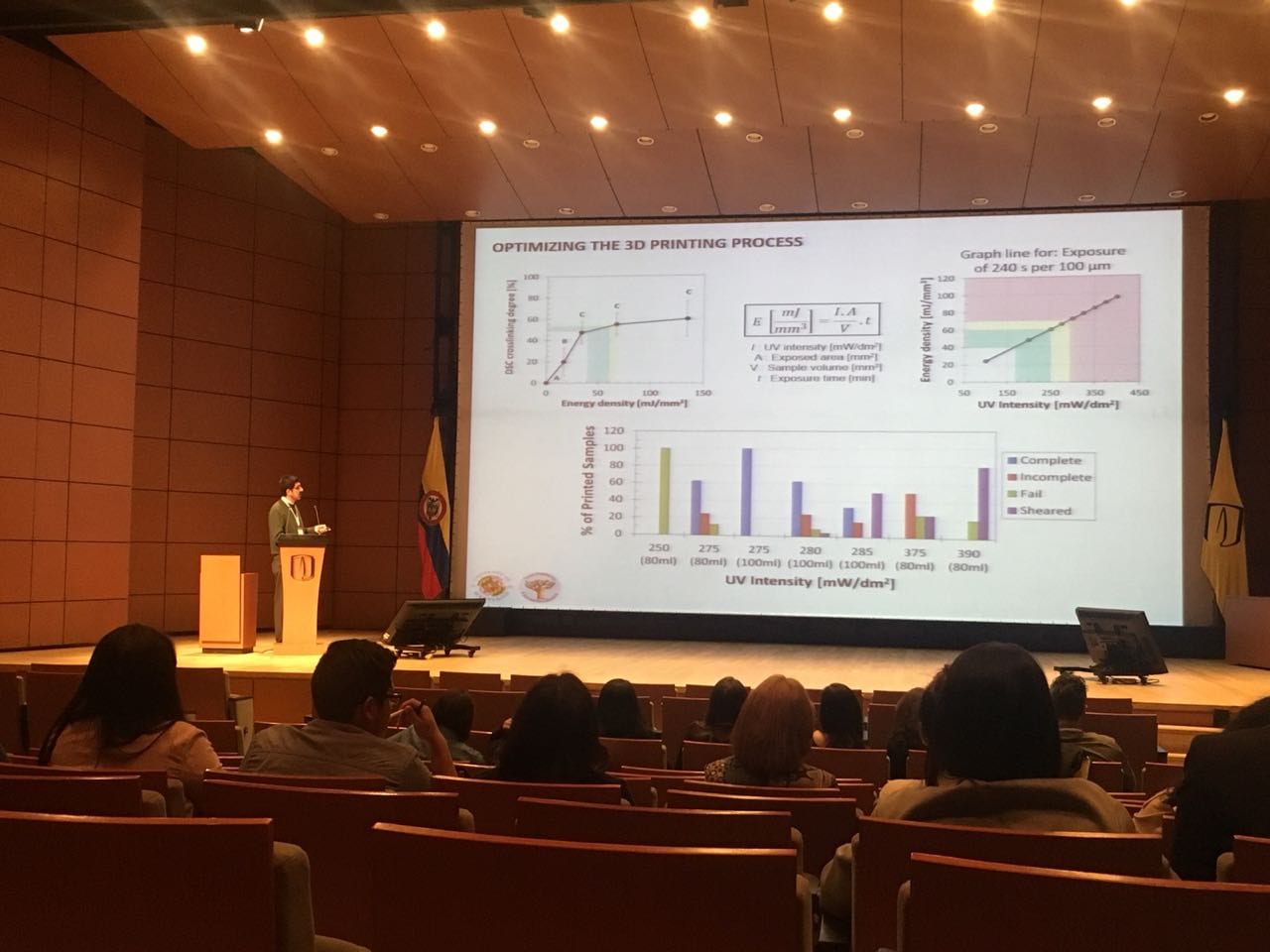
Javier Navarro giving his presentation at SIB in Colombia

TEBL member Javier Navarro spoke at the IX Seminary on Biomedical Engineering (SIB) at the Universidad de Los Andes in Bogotá, Colombia. The event took place May 16 – 19, 2018. Javier’s talk was entitled Assessment of the Effects of Energy Density in Crosslinking of Keratin-Based Photo-Sensitive Resin.”

The presentation was about keratin and the creation of a resin designed for 3D printing keratin. This resin was then used to determine how much energy projected during curing defines different properties of keratin hydrogels. Navarro and other TEBL members Jay Swayambunathan, Marco Santoro, and John P. Fisher found that energy density regulated the chemical reaction needed to crosslink keratin and determines how much the hydrogels crosslink. This, when taken together with its saturation nature, determine microstructural properties of the hydrogel. By understanding the role of energy density in creating the crosslinked network, they were able to adjust the printing parameters of the resin in a cDLP 3D printing system.

For more information, the IEEE proceedings article can be found here.

Navein Arumugasaamy Recognized at TERMIS

TEBL lab member Navein Arumugasaamy was awarded 3rd Place for the SYIS Oral Presentation Award at the TERMIS World Congress. The award was for his presentation given during the conference, which took place September 4 – 7, 2018 in Kyoto, Japan.

The presentation was entitled “A Placenta-Fetus Model to Evaluate Maternal-Fetal Transmission and Fetal Neural Toxicitiy of Zika Virus.” The topic of the talk relates to recent TEBL publication “Biomimetic Placenta-Fetus Model Demonstrating Maternal-Fetal Transmission and Fetal Neural Toxicity of Zika Virus.” When asked about the award, Arumugasaamy shared, “It’s wonderful to be recognized for our project assessing Zika Virus effects with a placental barrier tissue model, and I’m humbled by the award. It was a great team effort across multiple labs and institutions, and I’m very appreciative of the opportunity to present our work and have it so well received.” Congratulations, Navein!

TEBL Article One of Journal’s Top 20 Most Downloaded Recent Papers.

Journal of Biomedical Materials Research has recently announced that “Collagen Hydrogel Scaffold Promotes Mesenchymal Stem Cell and Endothelial Cell Coculture for Bone Tissue Engineering” was one of the journal’s top 20 most downloaded recent papers. The journal examined the number of downloads within the first 12 months of online publication for papers published between July 2016 and June 2018. The article was written by TEBL members Bao-Ngoc B. Nguyen, Rebecca Moriarty, Tim Kamalitdinov, Julie M. Etheridge, and John P. Fisher and looks at the role of collagen hydrogel scaffolds and microenvironments in bone tissue engineering. This article helped advance the field of tissue engineering as well as brought visibility to both the journal and our lab. Congratulations, Bao, Becca, Tim, Julie, and John!